ABOUT THIS COURSE
This course interweaves narrative and visuals to create a helpful guide to sorting stuff out.
It takes you through all the important skills you need to be effective at work, and in life generally.
It covers thinking, doing, working, planning and prioritizing, through to presenting, selling, negotiating, and progressing in your career.
The result is a practical series of working practices and a large amount of wise advice based on over 250 visuals that anyone can use to work effectively.
All in all, this a highly comprehensive package on innovation and idea generation that you can use again and again throughout your working life.
Who is it aimed at
- Anyone who is interested in working more intelligently
- All students, office workers, people who need to get organized
- Anyone who finds it difficult to get stuff done
- Anyone who wants to present, sell and negotiate better
- Anyone who wants to progress in their career
How it works
• 5 modules, each with 10 parts
• Video = 30-40 minutes per module
• Support material, exercises and downloads
• Allow 1 hour per module
• 5-6 hours for the whole course
What you get out of it
• Complete confidence in all aspects of working
• A suite of 50 techniques you can use again and again
• Intelligent approaches to help any business or individual
The Modules
Module 1: Thinking & Planning
Module 2: Working & Doing
Module 3: Prioritizing & Negotiating
Module 4: Presenting & Selling
Module 5: Progressing Your Career
Bonus material: Joking
KEVIN DUNCAN

Kevin is a business adviser, marketing expert, motivational speaker and author.
He is the UK’s best selling business author. He has written over 20 books, which have sold over 250,000 copies. They have been voted Telegraph Business Club Book of the Week, WHSmith Book of the Month, Foyles Book of the Month, nominated for CMI Management Book of the Year, and translated into over a dozen languages.
After 20 years in advertising and direct marketing, he has spent the last 20 years as an independent troubleshooter, advising companies on how to improve.
In agencies, he worked with over 400 clients, deployed £600m of funds on more than 200 brands, oversaw over 1,000 projects, and won 35 awards for creativity and effectiveness.
As Expert Advice, Kevin has completed over 800 jobs for 180 clients, including Dentsu, Design Bridge, Discovery Channel, EE, Facebook, The Guardian, Havas, Hearts & Science, Initiative, Iris, JLL, JWT, London School of Economics, M&C Saatchi, Metro, Mediacom, Mindshare, Moonpig, News UK, Ogilvy, Publicis, RBS, Royal Mail, Saatchi & Saatchi, Strutt & Parker, UM, and the World Federation of Advertisers.
EXAMPLE CONTENT
.
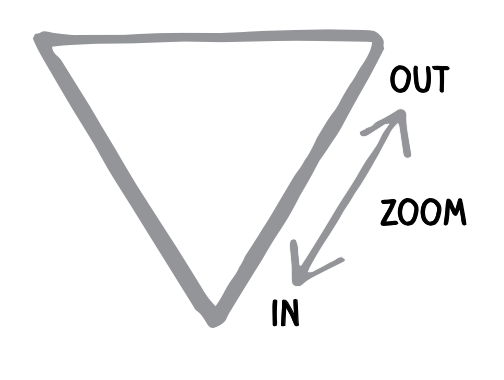
Modern business comes with a built-in dilemma: how to cope with the big picture and the detail at the same time. This is an issue that vexes business leaders. On the one hand they are concerned with the overall strategic direction of a company and, on the other, they are perpetually dragged into specific operational detail. The knack is to be able to zoom in and zoom out fast, all day, every day. Zooming out reveals the big picture, and zooming in shows the detail. The first is all about widening options and attaining distance. The second is all about understanding the true operational or technical detail.
.
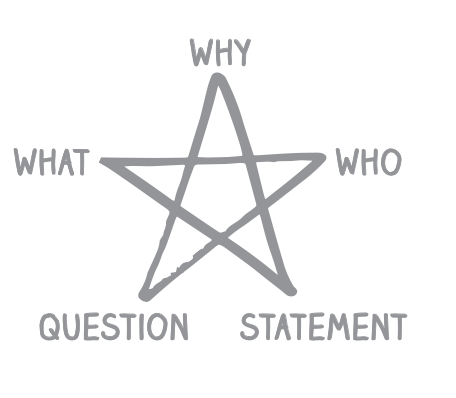
When it comes to topics, first we must establish that we truly know what we are doing – easier said than done in many companies. One way to do this is to use a briefing star to clarify five points. Start with what: what are we trying to achieve? This must be bullshit-free so everyone is clear. Then answer the question why: why are we doing this? There must be a clear reason or commercial imperative. Then who: who has the ability to approve or reject our proposal? Name an individual so you know who your audience is. The bottom two points of the star usually match the topic/thing distinction. The question is often qualitative and is a tricky, large issue to address: what are we trying to solve here? That’s a topic. The statement is usually an objective – a quantitative task to do or a target to hit. That’s a thing.
.
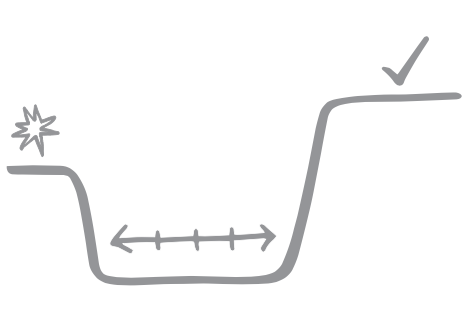
It doesn’t matter how long a presentation lasts, it always follows the same pattern. Research shows that people remember 70% of what you say at the beginning, 100% of what you say at the end, and only 20% of what was in the middle. This remains true regardless of how long the presentation is. In the middle is what has become known as the bed of nails. This is the section you need to get out of as fast as possible, because it’s usually boring and convoluted. So your main approach when preparing to present should be to concentrate on: 1. A really strong start. 2. A memorable finish. 3. A tight, cogent middle section.
COURSE CONTENT
Other courses for you .....
Let’s keep in touch
Subscribe to the mailing list and receive the latest updates